

Terra Classic Burns Surge as Community Pushes Deflation Forward

Terra Classic has recorded a notable increase in its daily burn activity, with token burns jumping by roughly seventy four percent in a single day. On January twenty nine twenty twenty six, approximately thirty nine million LUNC were permanently removed from circulation, compared to just over twenty two million the previous day. While this amount is small relative to the overall supply, the sharp increase highlights persistent on chain activity and a community that remains focused on long term supply reduction despite challenging market conditions.
Read Also: SHIB Burn Rate Explodes in Rare Deflationary Event
This recent spike has been widely interpreted as a sign of resilience. In periods of weak price action and low trading volume, consistency in burns becomes more important than headline numbers, reinforcing confidence that deflationary mechanisms are still functioning.
Community Led Upgrades Driving Structural Improvement
Beyond daily burns, the Terra Classic community continues to prioritize infrastructure upgrades aimed at strengthening the chain’s economic design. A major focus is the planned upgrade to Cosmos SDK fifty three, which is intended to modernize the network in a single streamlined step. This approach reduces technical risk while enabling improved interoperability, governance efficiency, and future scalability.
Alongside this, the proposed reactivation of the Market Module introduces a more controlled framework for swaps and fees. Under the updated model, fees generated through on chain activity can be burned or redirected into protocol revenue without reintroducing unchecked minting. Together, these upgrades are designed to support sustainable deflation rather than short term hype.
Exchange Burns Remain a Key Catalyst
Exchange driven burns have historically played a significant role in Terra Classic price movements. Past large burns by major exchanges, particularly Binance, have occasionally triggered sharp but short lived rallies by removing billions of tokens at once and boosting trading volume. These events demonstrate how external support can amplify community efforts, even if the effect fades once momentum cools.
Read Also: SHIB Burn Rate Explodes in Rare Deflationary Event
As a result, community members continue to advocate for consistent exchange participation, viewing it as a complementary force to on chain burns rather than a replacement for organic growth.
The Supply Challenge Still Looms Large
Despite steady progress, Terra Classic still faces a massive supply hurdle. With total supply hovering above six trillion tokens, even tens of millions burned daily represent only incremental change. Cumulative burns have removed hundreds of billions so far, yet the scale required for dramatic price appreciation remains significant.
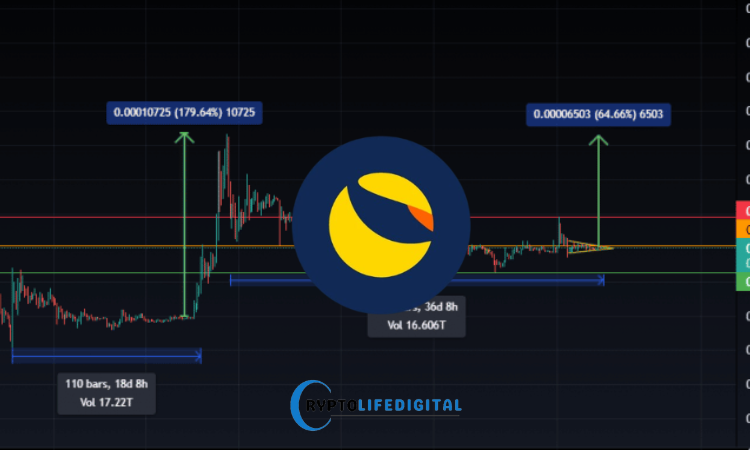
Price action reflects this reality. LUNC continues to trade in a narrow range, weighed down by broader market turbulence and subdued speculative interest.
Resilience Through Consistency and Staking
What stands out is the ecosystem’s durability. Burns continue even during quiet weeks, validators remain active, and staking participation provides stability to the network. Rather than relying on sudden narratives, Terra Classic is advancing through incremental improvements, steady deflation, and community coordination.
In the current market climate, that consistency may prove more valuable than volatility driven spikes, positioning LUNC for gradual recovery if broader conditions improve.
Follow us on Facebook, Telegram, and Google News.
Meet Raliat: A rising star in the crypto world, blending expertise with a passion for analysis. With a knack for simplifying complex concepts, she empowers audiences to understand and navigate the blockchain landscape. Raliat’s insightful content and analytical prowess make her a trusted guide in the ever-evolving world of cryptocurrency.